


Nov
Peptide reconstitution is where most research material is lost, and almost none of it is lost dramatically. Done carelessly, peptide reconstitution turns good material into mediocre material without ever looking like it has. There is no bang. A cartridge that was handled slightly wrong looks identical to one that was handled correctly, and the difference only shows up later as data that will not replicate. This peptide reconstitution guide covers the solvent choice, the volume decision, the technique itself, and the peptide storage windows on either side of it, for lyophilised peptides, proteins and the small molecules that behave differently from both.
On this page
What reconstitution actually does
Lyophilisation removes water from a frozen solution by sublimation under vacuum, leaving a dry porous cake that is stable for years because the chemistry that degrades peptides needs water to proceed. Hydrolysis, deamidation and most oxidation pathways all run in solution and effectively stop in a dry solid, which is why peptide stability is measured in years before reconstitution. That is the entire reason material ships lyophilised rather than pre-mixed.
Peptide reconstitution reverses that protection deliberately. The moment solvent enters the cartridge you have restarted every degradation pathway the freeze drying suspended, and the clock on the material starts running in weeks rather than years. Nothing about this is avoidable, since the compound has to be in solution to be used, but it does reframe what you are doing. You are not preparing material. You are starting its shelf life.
Everything else in this guide follows from that single fact. Good peptide reconstitution technique is simply about not accelerating what you have just started, and good peptide storage afterwards is about the same thing.
Choosing the solvent
Two peptide reconstitution solvents come up, and they are not interchangeable. Bacteriostatic water is sterile water containing roughly 0.9 percent benzyl alcohol as a preservative, which suppresses microbial growth and therefore permits repeated withdrawals from the same container over a period of weeks. Sterile water contains no preservative at all, so once the seal is broken the contents are single use for practical purposes.
For any multi-dose cartridge, which is what every pen in our range is, bacteriostatic water is the correct peptide reconstitution solvent and it is what ships in the kit. The preservative is the only thing making a two or four week working window possible. Reconstituting a multi-dose cartridge with plain sterile water gives you a sterile solution for about five minutes and an uncontrolled one thereafter.
There is a narrow exception. A small number of peptides are sensitive to benzyl alcohol, and some protein work specifies preservative free solvent for that reason. If a protocol calls for sterile water, follow the protocol and treat the cartridge as single session material. Do not split the difference.
Choosing the volume, which is permanent
This is the decision people make carelessly and cannot undo. The mass in the cartridge was fixed at production. The concentration is fixed by you, at the moment of peptide reconstitution, and it stays fixed for the life of that cartridge. Forty milligrams into 2ml gives 20mg per ml. The same forty into 8ml gives 5mg per ml. Same pen, same label, four times apart.
Decide the peptide reconstitution volume before you open anything, and measure what actually goes in rather than assuming the ampoule emptied completely. Residue left in the ampoule means your true concentration is higher than your calculated one, which is the quiet version of this error and the one nobody catches.
Our retatrutide dosage calculator guide works the conversion from mass and volume through to milligrams per graduation, with a reference table covering the five volumes most often used.
The technique, step by step
- Let it reach room temperature before peptide reconstitution. Twenty minutes out of the fridge. Cold solvent dissolves a lyophilised cake slowly, and slow dissolution is what tempts people into agitating it.
- Check the batch code against the certificate. The mass figure on the certificate is the number every subsequent calculation rests on, not the number on the carton.
- Measure the solvent deliberately. Decide and record the volume before the first drop goes in.
- Run the stream down the wall. Angle the cartridge and let the solvent flow down the inner glass, never directly onto the cake. A jet hitting dry powder drives it into the air and shears it at the interface.
- Wait. Leave the lyophilised cake to dissolve on its own, which can take several minutes for a dense cake. Patience here costs nothing and saves material.
- Swirl if needed, never shake. A slow roll between the fingers is acceptable. Anything more vigorous is covered in the next section.
- Calculate and label immediately. Concentration per millilitre, concentration per graduation, and the date, written on the barrel. Five seconds now, versus an unusable cartridge in a month.
Why shaking is unforgivable
Of all the peptide reconstitution errors, shaking is both the most common and the only one that is instantly irreversible. The mechanism is worth understanding rather than just being told to avoid.
Peptides and proteins are surface active, meaning they migrate to the boundary between liquid and air and partially unfold when they get there. Shaking generates an enormous amount of that boundary, in the form of bubbles and foam, and every bubble is a surface where molecules unfold, expose their hydrophobic interiors and stick to one another. The result is aggregation, which is not reversible by waiting, warming, or further mixing.
Visible cloudiness that will not clear is aggregated material. It is also the visible fraction, which means the invisible fraction is larger. A solution that looks slightly hazy has lost more peptide than it appears to have lost, and the quantity in the barrel no longer matches the quantity in your notes.
Storage, before and after
Lyophilised, before mixing
Stable for years frozen, many months at 2 to 8 degrees Celsius. Keep sealed and out of light. Do not cycle it in and out of the freezer repeatedly, because each freeze and thaw does damage and the damage adds up.
In solution, after peptide reconstitution
Weeks rather than months, at 2 to 8 degrees Celsius, upright and out of light. Never freeze a reconstituted cartridge. Ice crystals shred structure and the material does not come back.
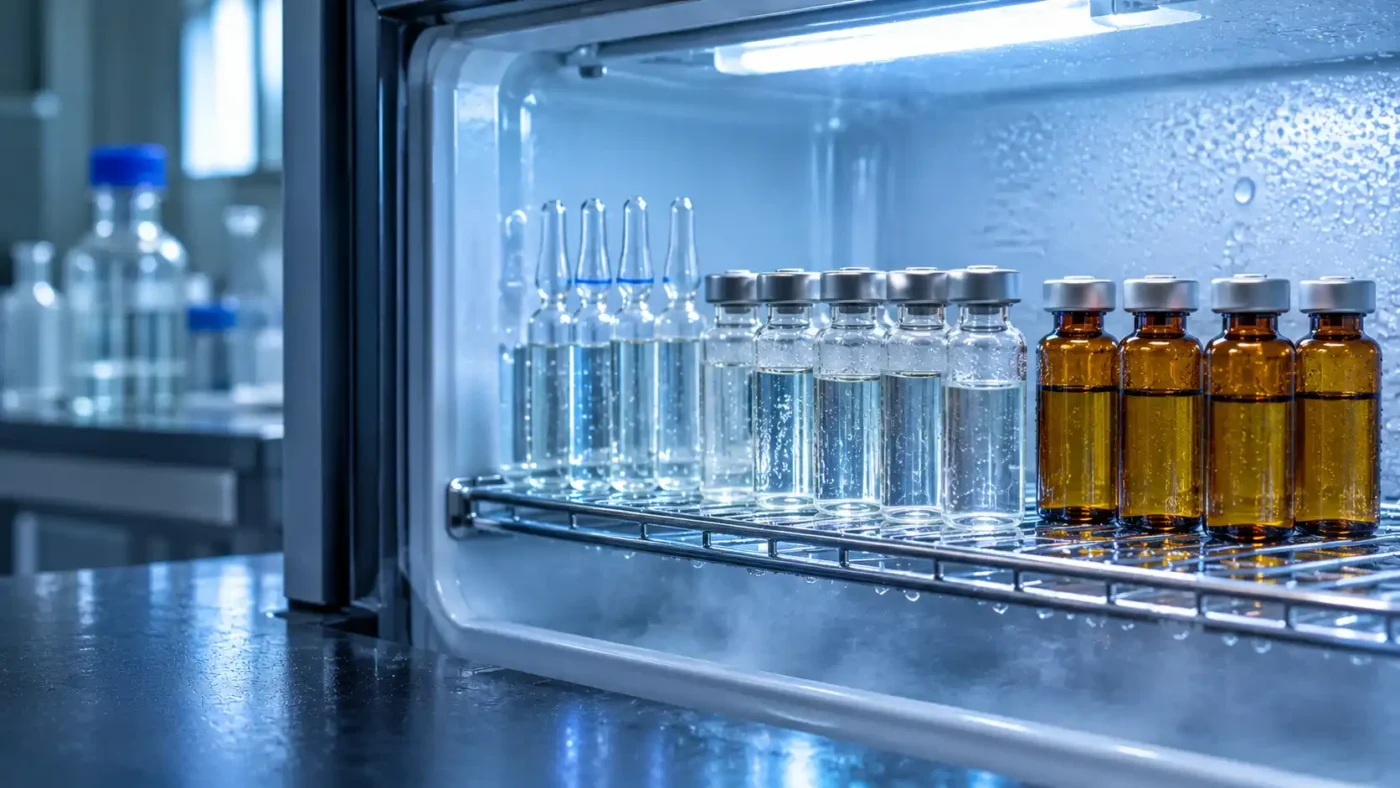
Peptide storage in the light matters more than people expect. Tryptophan and tyrosine residues are photosensitive, so a clear cartridge left on a sunlit bench degrades measurably faster than one kept in the dark. Amber glass handles part of it. A closed fridge handles the rest.
Temperature excursions in transit are the other common peptide storage loss. This is why every Synedica order ships in an insulated outer with a cold pack sized for the transit time, and why we confirm cold chain arrangements before sending anything internationally rather than afterwards.
Signs something has gone wrong
- Cloudiness or haze that does not clear on standing, which indicates aggregation.
- Visible particles or flecks in an otherwise clear solution.
- Persistent foam on the surface hours after mixing.
- A cake that will not dissolve at all, which can indicate a solubility mismatch with the solvent rather than damage.
- Any colour change from colourless, which is never a good sign in this class of material.
How it differs by molecule type
Not everything in a catalogue of research peptides behaves the same way, and peptide reconstitution technique scales with how large and how folded the molecule is. So does peptide solubility.
Short chains are the most forgiving. The BPC157 and TB500 pen kit holds a fifteen amino acid peptide and a short synthetic fragment, both small enough that they tolerate ordinary handling reasonably well. The GLP-1 compounds in the Synedica Retatrutide 40mg pen kit and the Synedica Tirzepatide 40mg pen kit sit in the middle, larger and more structured, and correspondingly less tolerant.
Full proteins are a different discipline. Somatropin in the Somatotropin HGH 120iu pen kit is 191 amino acids at roughly 22 kilodaltons, which is five times the size of the GLP-1 compounds and has a tertiary structure to lose. It denatures where a short chain would survive, it must never be frozen once reconstituted, and foaming it is close to a total loss.
At the other end, the Biotin 40mg pen kit holds a 244 dalton small molecule with no folded structure at all, so shearing is not a concern, though limited aqueous peptide solubility rules do still apply and it needs more time and patience than the peptides do.
Where to read the primary research
- Peptide and protein stability, aggregation at interfaces and formulation science through PubMed Central.
- Solubility data, molecular weights and compound properties on PubChem.
- Protein sequences and structural data on UniProt.
- UK medicines and device guidance from the MHRA, and injection safety and waste handling guidance from the World Health Organization.
The Synedica range
Every kit in the Synedica catalogue of research peptides ships with the correct solvent for its contents and a handling booklet carrying the concentration table for that fill, so the peptide reconstitution arithmetic is done before you start. The full range sits on the Synedica homepage, and the individual products are below.
The device side of this is covered in how to use a peptide pen. For a quotation, or the certificate of analysis for the batch currently in stock before you buy peptides uk side, reach us through the contact page.

Pingback: Retatrutide Dosage Calculator | Best UK Peptide Guide
Pingback: How To Use A Peptide Pen | Best UK Peptide Guide
Pingback: Melanotan 2 Nasal Spray Dosage | Best UK Peptide Guide