


Nov
Learning how to use a peptide pen properly takes about ten minutes and saves a great deal of wasted material. The device is simple, but almost every step in how to use a peptide pen has a version that looks correct and quietly costs you accuracy, and most of the guidance online skips straight past them. This guide to how to use a peptide pen covers the sequence from sealed carton to a labelled, ready cartridge, including the two steps people reliably get wrong.
On this page
How peptide pens work
Ask how do peptide pens work, or how to use peptide pen hardware correctly, and the short answer is the same. They replace a judgement with a mechanism. Drawing a small volume from a vial with a syringe requires you to read a meniscus against a scale by eye, and you do it again on every single draw. Each reading carries its own small error, and across a study those errors accumulate into variance that nobody can account for afterwards.
A reusable injection pen for peptides removes the reading. The cartridge sits inside a body with a threaded plunger, and the dial advances that plunger by a fixed, engineered increment per click or per graduation. You are no longer estimating a volume. You are counting an increment whose size was set at manufacture. That is the mechanical argument for the format, and the reason a peptide injection pen or peptide injector pen costs more than a vial holding the same material.
The second thing to understand about how to use a peptide pen efficiently is dead volume. A syringe hub and needle retain a measurable amount of liquid that never comes out, and on an 8mg or 20mg fill that loss is worth money. A peptide pen injection draws from a sealed cartridge with a travelling plunger, so there is far less left behind.
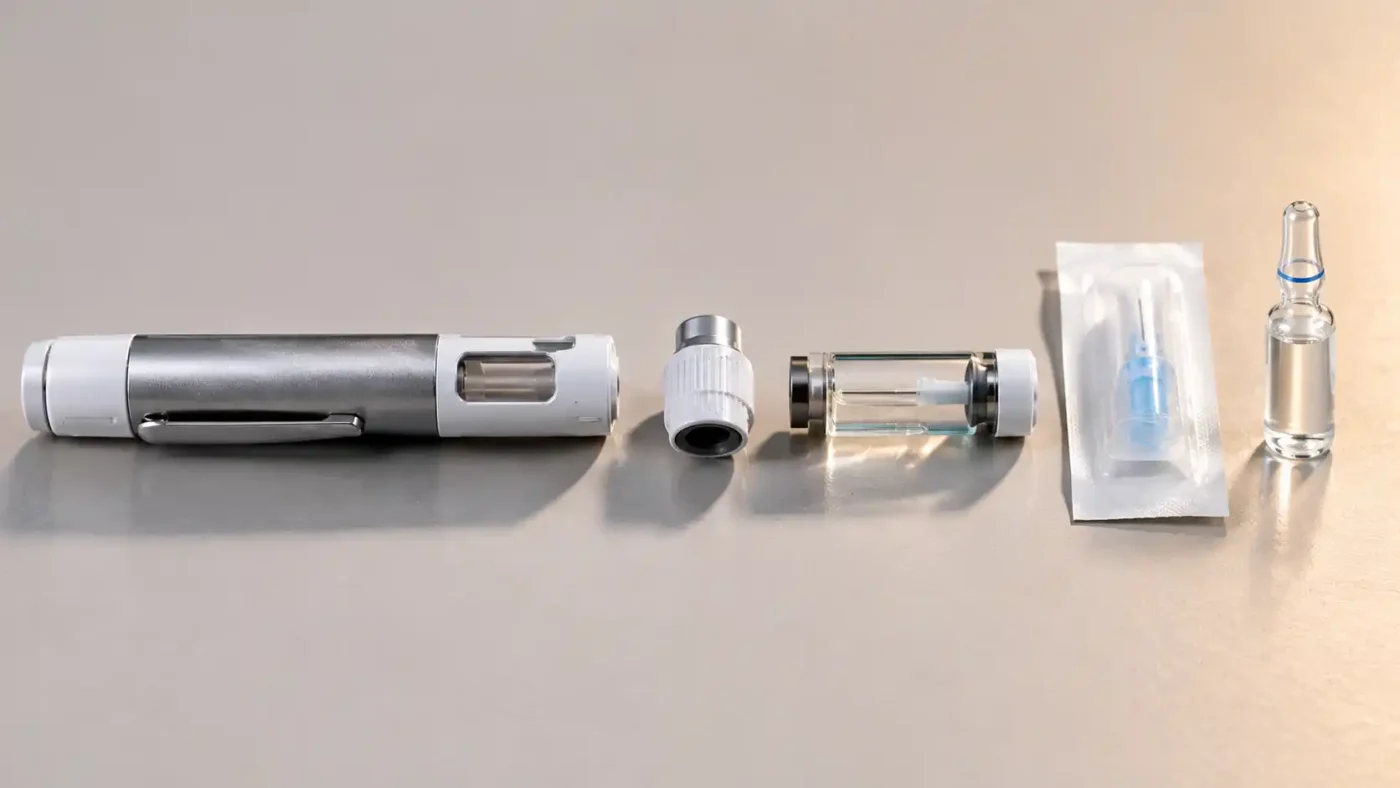
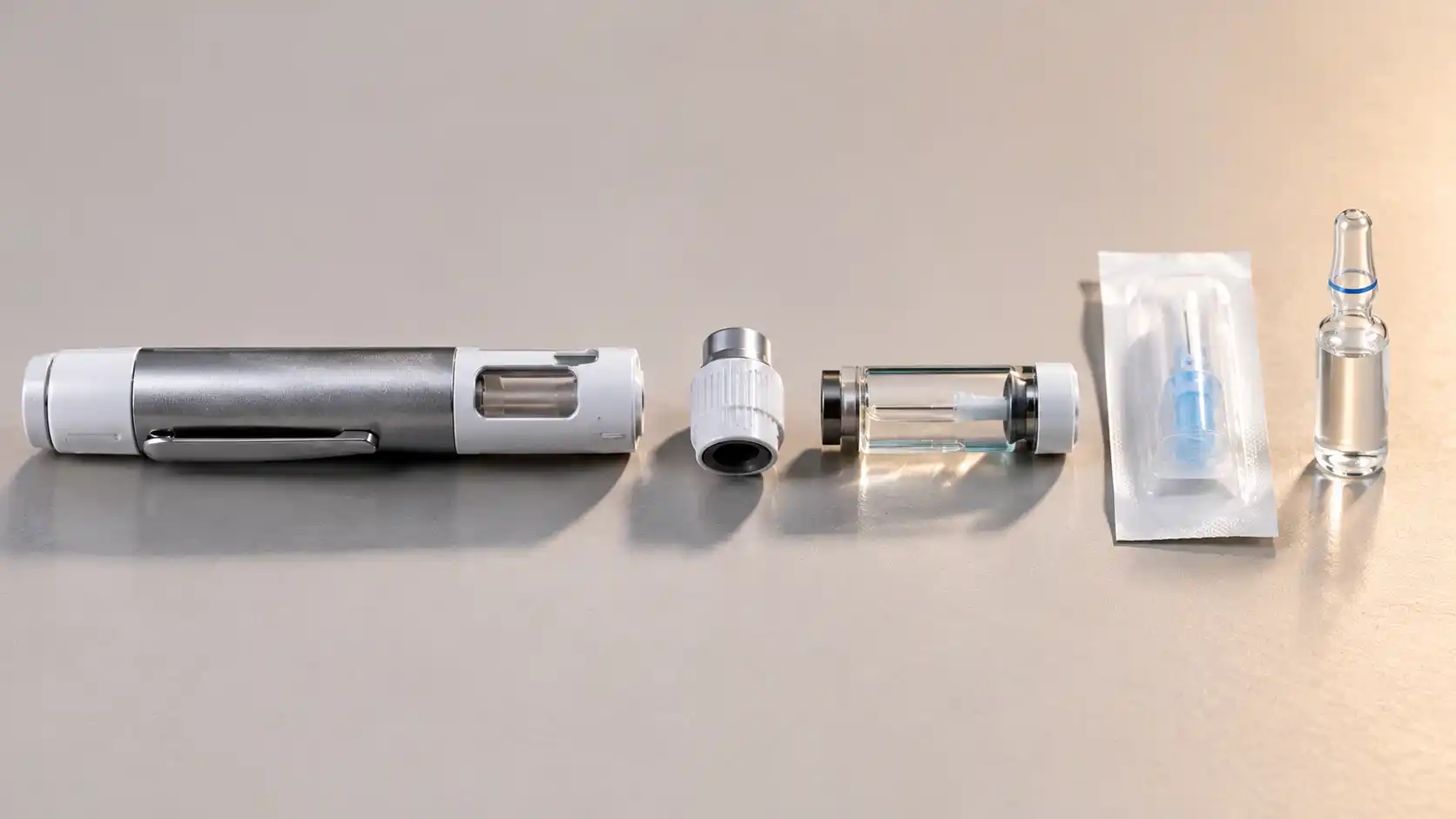
The parts, and what each one does
Body and dial
Holds the threaded plunger. The dial sets how far it travels, which is what fixes your increment.
Cartridge
Glass, graduated, sealed with a rubber stopper at each end. This is where the peptide lives.
Needle
Screws onto the cartridge end and pierces the stopper. Single use, then it goes to sharps.
Solvent ampoule
Bacteriostatic solution for reconstitution, volume matched to the fill in the cartridge.
The sequence, step by step
Work on a clean surface with everything laid out before you start, because how to use a peptide pen well is mostly preparation. Knowing how to use a peptide pen is mostly a matter of not improvising halfway through.
- Check the batch code. Read it off the barrel and confirm it matches the certificate of analysis you were sent. Everything downstream depends on the mass figure being right, so this is not a formality.
- Bring the cartridge to room temperature. Take it out of the fridge and leave it twenty minutes. Cold solvent dissolves lyophilised peptide more slowly and tempts people into shaking it.
- Measure the solvent. Decide your volume before you open anything, because that figure sets your concentration permanently. Do not assume the whole ampoule went in, as residue left behind raises your concentration above what you calculated.
- Reconstitute slowly. Direct the stream down the inner wall of the cartridge, not onto the cake. Let it dissolve on its own. Swirl gently if it is slow, never shake, because agitation shears peptide and the haze will not clear.
- Calculate and label. Work out milligrams per millilitre and per graduation, then write it on the barrel with the date. This is the step most people skip and the one that costs them a month later.
- Load the cartridge and fit a needle. Seat it fully, screw the needle on straight rather than at an angle, and remove the outer cap.
- Prime the peptides pen. Advance the dial a couple of graduations and expel into a tissue until liquid appears. The chamber has to fill before any reading is accurate.
Reading the graduations
A graduation is a fraction of a millilitre, and which fraction depends on the pen. Common scales put one hundred graduations to the millilitre, so a single mark is 0.01ml, but this is a property of your hardware rather than a universal standard, and confirming it is the difference between a correct figure and a hundredfold error.
Once you know the scale, the rest of how to use a peptide pen accurately is one multiplication. At a concentration of 10mg per ml, one graduation of 0.01ml holds 0.1mg, which is 100 micrograms. Change the reconstitution volume and that figure changes with it, which is why a peptide pen calculator is a concentration tool rather than a device setting. Our retatrutide dosage calculator guide works the conversion through with a full reference table.
One scale that does not interchange is international units. Growth hormone is measured in iu rather than milligrams, as set out on the Somatotropin HGH 120iu pen kit page, and carrying a milligram habit onto a unit scale produces a threefold error that no pen will warn you about.
Priming, and why it matters
Priming is the step in how to use a peptide pen most often treated as optional, and it is not. Between the cartridge stopper and the needle tip there is an air gap, and until liquid has displaced that air the first advance of the plunger delivers less than the graduation says. People who skip priming get a short first measurement and then wonder why the cartridge runs out earlier than the arithmetic predicted.
How to use a peptide pen without losing material means priming after every needle change, not only at first use, because fitting a fresh needle reintroduces the air gap. Two graduations into a tissue is usually enough. If nothing appears after four or five, stop and check the cartridge is seated properly rather than continuing to advance the dial.
Needles and sharps handling
How to use a peptide pen safely starts with the needles, which are single use. Reusing one blunts the tip, risks contaminating the cartridge contents through the stopper, and is a false economy given that fourteen come in the kit. Fit straight, never force, and if it does not thread cleanly take it off and start again rather than cross threading the collar.
Leave the needle off the pen between sessions. Storing a pen with a needle attached lets air into the cartridge and lets solution wick out of the tip, both of which change the concentration you labelled. Cap the cartridge end instead.
Used needles go into a rigid sharps container, never into general waste. The World Health Organization publishes guidance on injection safety and healthcare waste handling that covers the standard properly.
Transferring from pen to vial
People ask how to transfer a peptide from pen to a vial fairly often once they have worked out how to use a peptide pen, usually because a protocol needs a different concentration than the one already prepared. It can be done, and it costs you something each time.
Every transfer introduces dead volume loss in whatever you move it with, a fresh opportunity for contamination, and a new concentration to calculate and label. More importantly, the calibration advantage disappears. The engineered increment belongs to the pen assembly, so once the liquid is in a vial you are back to reading a syringe by eye, which is the problem the pen existed to solve.
If a design genuinely needs a different concentration, the cleaner answer is to reconstitute the next cartridge at the volume you actually want rather than moving solution between containers.
Seven mistakes that waste material
- Shaking the peptides pen to speed up dissolution. It shears the peptide and the cloudiness is permanent.
- Reconstituting before deciding the volume, which fixes a concentration you did not choose.
- Not labelling the barrel, so the concentration is unrecoverable a few weeks later.
- Skipping the prime, then counting the short first measurement as a full one.
- Assuming the graduation scale instead of confirming it against the pen you are holding.
- Storing with the needle fitted, which lets air in and solution out.
- Directing the solvent stream onto the lyophilised cake rather than the cartridge wall.
Further reading
For the science behind peptide stability, solubility and handling losses, rather than the device mechanics, these are the primary sources:
- Peptide stability, aggregation and formulation literature through PubMed Central.
- Compound data, solubility and molecular weights on PubChem.
- UK device and medicines guidance from the MHRA.
The Synedica range
Every pen in the Synedica catalogue of research peptides uses the same body, the same needle thread and the same documentation standard, so learning how to use a peptide pen once covers every product we sell. A peptide pen calculator is unnecessary because the handling booklet in each kit carries the concentration table for that fill. The full catalogue sits on the Synedica homepage, and the individual products are below.
The storage side of this is covered in our peptide reconstitution and storage guide. For a quotation, or the certificate of analysis for the batch currently in stock, reach us through the contact page.

Pingback: Retatrutide Vs Tirzepatide Vs Semaglutide | Best Guide
Pingback: Peptide Reconstitution And Storage | Best UK Guide